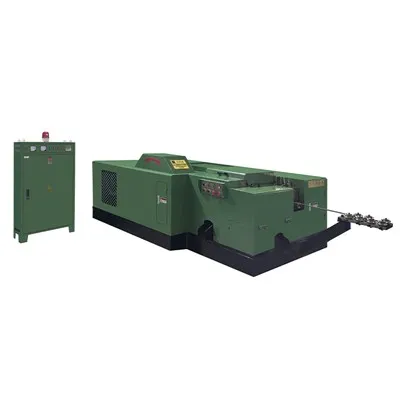
When it comes to the manufacturing industry, cold forge header machines play a crucial role in the production of various fasteners and metal components. As a leading supplier of cold forge header machines, I often receive inquiries about the speed adjustment range of these machines. In this blog post, I will delve into the details of the speed adjustment range of cold forge header machines, its significance, and how it impacts the manufacturing process.
Understanding the Cold Forge Header Machine
A cold forge header machine is a specialized piece of equipment used to form metal parts through cold forging processes. Cold forging involves shaping metal at room temperature, which offers several advantages such as improved material properties, higher precision, and reduced energy consumption compared to hot forging. These machines are commonly used in the production of bolts, nuts, rivets, and other fasteners.
The Importance of Speed Adjustment
The speed adjustment range of a cold forge header machine is a critical factor that directly affects the production efficiency and quality of the manufactured parts. By adjusting the machine's speed, manufacturers can optimize the production process based on the specific requirements of the part being produced. For instance, when producing small and simple parts, a higher speed can be used to increase production output. On the other hand, when manufacturing complex or high - precision parts, a lower speed may be necessary to ensure accurate forming and prevent defects.
Typical Speed Adjustment Range
The speed adjustment range of a cold forge header machine can vary significantly depending on the model and design of the machine. Generally, the speed of these machines is measured in strokes per minute (SPM). Most cold forge header machines have a speed adjustment range starting from around 50 SPM to as high as 300 SPM or more.
In the lower end of the range, speeds around 50 - 100 SPM are often used for processes that require high precision and careful forming. For example, when working with delicate materials or producing parts with intricate geometries, a slower speed allows for better control over the forging process, reducing the risk of cracking or deformation.
As the speed increases, up to 150 - 200 SPM, the production rate significantly improves. This range is suitable for medium - sized parts with relatively simple shapes. The machine can operate at a faster pace while still maintaining a reasonable level of quality.
For high - volume production of standard parts, speeds above 200 SPM can be achieved. Some advanced cold forge header machines can reach speeds of 300 SPM or even higher. At these high speeds, the machine can produce a large number of parts in a short period, making it ideal for mass production.
Factors Affecting the Speed Adjustment Range
Several factors influence the speed adjustment range of a cold forge header machine.
Material Properties
The type of material being forged is a major factor. Softer materials such as aluminum and brass can generally be forged at higher speeds compared to harder materials like steel. Harder materials require more force to deform, and higher speeds may lead to excessive wear on the tooling or cause the part to crack.
Part Complexity
The complexity of the part design also affects the speed. Parts with complex shapes or multiple forming steps may require slower speeds to ensure proper forming. For example, a part with undercuts or internal features may need more time for the material to flow into the desired shape.
Tooling Design
The design and quality of the tooling used in the cold forge header machine play a crucial role. Well - designed tooling can withstand higher speeds and ensure consistent part quality. Poorly designed or worn - out tooling may limit the machine's speed and increase the risk of defects.
Our Cold Forge Header Machine Offerings
As a supplier of cold forge header machines, we offer a wide range of models with different speed adjustment ranges to meet the diverse needs of our customers. Our machines are designed with advanced technology and high - quality components to ensure reliable performance and long - term durability.
If you are interested in our Stainless Steel Machinery Cold Heading Machine, it is specifically designed for working with stainless steel materials. It offers a flexible speed adjustment range that allows you to optimize the production process for different stainless steel parts.
Our Cold Forming Equipment is suitable for a variety of cold forging applications. With its adjustable speed, you can easily adapt to different production requirements, whether it's for small - scale production or large - volume manufacturing.
For those in need of a more powerful solution, our Cold Forging Press Heading Machine provides a wide speed adjustment range and high - precision forming capabilities. It is ideal for producing high - quality fasteners and metal components.
Contact Us for Purchase and Consultation
If you are looking to invest in a cold forge header machine or have any questions about the speed adjustment range and its impact on your production process, we are here to help. Our team of experts can provide you with detailed information, technical support, and guidance on selecting the right machine for your specific needs.


We understand that every manufacturing operation is unique, and we are committed to providing customized solutions to meet your requirements. Whether you are a small - scale workshop or a large - scale industrial manufacturer, we have the right cold forge header machine for you.
References
- Smith, J. (2018). Cold Forging Technology: Principles and Applications. Industrial Press.
- Johnson, R. (2020). Advanced Manufacturing Processes: Cold Forging. Taylor & Francis.