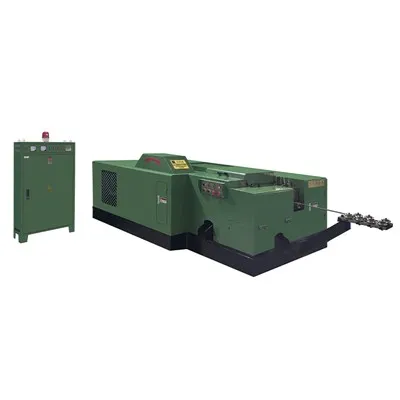
The servo system plays a crucial role in an Automatic Cold Heading Machine, a product we are proud to supply. As a leading provider in the industry, we understand the significance of every component in the machine, and the servo system is no exception. In this blog, we will delve into the functions of the servo system in an Automatic Cold Heading Machine and how it contributes to the overall performance and efficiency of the machine.


Precise Motion Control
One of the primary functions of the servo system in an Automatic Cold Heading Machine is to provide precise motion control. The servo motor, which is a key component of the servo system, can accurately control the speed, position, and torque of the machine's moving parts. This precision is essential in cold heading operations, where even the slightest deviation can result in defective products.
For example, in the process of cold heading, the servo system can precisely control the movement of the punch and die. It ensures that the punch moves at the right speed and force to form the metal workpiece into the desired shape. The ability to control the motion with high precision allows for the production of high - quality fasteners and other cold - headed products with tight tolerances.
Improved Efficiency
The servo system significantly improves the efficiency of an Automatic Cold Heading Machine. By precisely controlling the motion of the machine, it reduces the cycle time of each cold - heading operation. The servo motor can quickly accelerate and decelerate, allowing for faster production rates.
Moreover, the servo system can optimize the power consumption of the machine. It only uses the necessary amount of power to perform the operation, which not only saves energy but also reduces the operating cost. In a production environment, where time and cost are critical factors, the improved efficiency provided by the servo system can give manufacturers a competitive edge.
Flexibility in Operation
Another important function of the servo system is to provide flexibility in the operation of the Automatic Cold Heading Machine. The servo system can be easily programmed to perform different cold - heading operations. Manufacturers can change the settings of the servo system to produce different types of products with varying shapes and sizes.
For instance, if a manufacturer needs to switch from producing small screws to larger bolts, they can simply adjust the parameters of the servo system. This flexibility allows for quick product changeovers, reducing downtime and increasing the overall productivity of the machine. It also enables manufacturers to respond quickly to market demands and produce a wider range of products.
Enhanced Quality Control
The servo system contributes to enhanced quality control in the cold - heading process. By providing precise motion control, it ensures that each cold - headed product meets the required quality standards. The servo system can detect any deviations in the motion or force during the cold - heading process and make real - time adjustments.
For example, if the punch force is too high or too low, the servo system can adjust the force to ensure that the product is formed correctly. This real - time monitoring and adjustment help to reduce the number of defective products and improve the overall quality of the production.
Safety Features
The servo system in an Automatic Cold Heading Machine also includes safety features. It can detect abnormal conditions such as over - current, over - temperature, and over - speed. When these abnormal conditions are detected, the servo system can automatically stop the machine to prevent damage to the equipment and ensure the safety of the operators.
In addition, the servo system can be integrated with other safety devices in the machine, such as emergency stop buttons and safety sensors. This comprehensive safety system provides a reliable protection for the machine and the operators.
Integration with Other Systems
The servo system can be easily integrated with other systems in the Automatic Cold Heading Machine, such as the control system and the feeding system. This integration allows for seamless operation of the machine and improves the overall functionality.
For example, the servo system can communicate with the control system to receive instructions and feedback. It can also work in conjunction with the feeding system to ensure that the metal workpieces are fed into the machine at the right time and in the right position. This integration enhances the efficiency and reliability of the machine.
Conclusion
In conclusion, the servo system in an Automatic Cold Heading Machine is a vital component that offers numerous benefits. It provides precise motion control, improves efficiency, offers flexibility in operation, enhances quality control, includes safety features, and can be integrated with other systems. As a Automatic Cold Heading Machine supplier, we are committed to providing high - quality machines with advanced servo systems to meet the needs of our customers.
If you are interested in our Cold Forging Header or Cold Forge Header Machine, please feel free to contact us for more information and to discuss your specific requirements. We look forward to working with you to achieve your production goals.
References
- "Servo Systems in Industrial Machinery" - A technical report on the application of servo systems in various industrial machines.
- "Cold Heading Technology and Its Advancements" - A research paper on the development of cold - heading technology and the role of servo systems.